And why the best clients I've ever had never came from a pain point.
Most of what you've been taught about selling follows the same pain point marketing playbook. Find the pain. Press on it. Offer the solution. Close while they're still feeling it.
I did this for almost three years. Webinars, ads, bonus stacking, urgency timers, the whole machinery. I was good at it, technically. I followed the "gold standard" that every online business coach was teaching, and I did it with precision because that's how my brain works. I wasn't looking for an alternative to pain point marketing because I didn't know there was one.
And it felt disgusting.
Not in a "this is hard and uncomfortable" way. In a "my body is telling me to stop" way. I ignored that signal for a long time because I assumed the discomfort was just part of learning to sell. Everyone around me was doing it. Everyone said this was how you make money online. So I kept going.
What I didn't understand at the time was that the method itself was producing a specific kind of result, and that result was the actual problem.
The playbook said press on the pain.
My body said this is going to come back as a refund.
It was a marketing problem.
What Happens in the Brain When Someone Buys From a Pain Point in Marketing
When you press on someone's insecurity, their fear, their "what if I'm falling behind" feeling, you're activating their amygdala. That's the fight-or-flight part of the brain. The part designed for survival, not for making considered decisions about who to hire or what course to take.
When the amygdala takes over, the prefrontal cortex goes quiet. That's the part responsible for rational evaluation, for weighing options, for asking "do I actually need this and does this person seem like the right fit?" This isn't a metaphor. Neuroscience research, including work by Knutson et al. on reward processing and brain imaging studies at Brunel University, has shown that urgency-based purchasing cues increase amygdala activation while suppressing prefrontal cortex activity. The brain literally shifts into a mode where self-control and rational evaluation are diminished.
So the person buys. They buy fast. They buy from urgency, from scarcity, from that adrenaline surge of "I need to act NOW before this opportunity disappears."
And then the adrenaline drops.
Could be an hour later. Could be that same evening. The rational brain comes back online and starts asking questions. Why did I buy this? What exactly am I getting? Does this person even know what she's talking about? I haven't done any research. I don't even know if this is what I need.
That's buyer's remorse. And it's not a character flaw in the buyer. It's a predictable neurological outcome of the marketing method that was used to close the sale.
The Downstream Cost of Pain Point Marketing on Client Quality and Retention
I used to think "difficult clients" were just part of doing business. Some people are easy to work with, some aren't. You take what you get.
What I didn't see, back then, was that the difficulty correlated almost perfectly with HOW the person had found me and what state they were in when they bought.
Clients who bought from a pain point, from urgency, from that adrenaline moment, showed up differently. They questioned the value before we even started working together. They were harder to onboard because they were already second-guessing whether this was a good decision. Some of them never showed up at all. They paid and then disappeared, which I now understand was them deciding the buyer's remorse was strong enough that they'd rather lose the money than sit through something they weren't sure about.
And they didn't refer anyone. Because how do you recommend something you're not even sure was right for you?

The refund requests, the no-shows, the clients who felt "off" from the first interaction. If you've ever wondered why clients ghost after buying, or why some people pay and then never schedule their first session, this is usually why. I used to file all of that under "delivery problems" or "wrong audience." Turns out, most of it was a marketing problem. The way I was acquiring people was pre-selecting for a certain brain state, and that brain state doesn't produce great working relationships. The marketing that doesn't feel sleazy also happens to be the marketing that produces clients who actually show up.
The Contrast: How Green-Brain Buyers Behave Differently in Sales Conversations
Around the same time, I started noticing a completely different pattern with a different kind of client.
These were people who found me through recommendation. Or they saw something I'd created, whether it was a blog post, an AI photoshoot I'd done, a piece of content where I'd shared how I actually think. They took their time. They looked around. They read more than one thing. And then they reached out, and when they did, they already knew what they wanted. Not because I'd told them what to want, but because they'd recognised something in my work that matched what they were looking for.
Those clients were different from the first conversation. They didn't need convincing. They didn't need bonus stacking or countdown timers to justify the price. They showed up ready to work, they got better results, and they told other people about it without me ever asking.
I didn't filter better. I didn't "attract" them through some mystical frequency thing. The mechanism was different. The way they found me produced a different kind of buyer. Someone who had made the decision with their full brain, not just the panicking part.
Selling to Clarity Instead of Panic in Online Business
I want to be precise here because I'm not saying "just be authentic and they'll come." That's magical thinking, and I've watched too many talented people go broke waiting to be discovered while posting affirmations about abundance.
What I'm saying is that there's a specific alternative to pain point marketing, and it produces measurably better business outcomes.
Instead of pressing on what's broken in the potential client, you demonstrate what you're capable of. You make your thinking visible. You show the quality of your work, the depth of how you see things, and you do it clearly enough that the right person can recognise it without you having to explain why they should be afraid of not having it.
The person who buys from this kind of marketing buys from their green brain, not their red brain.
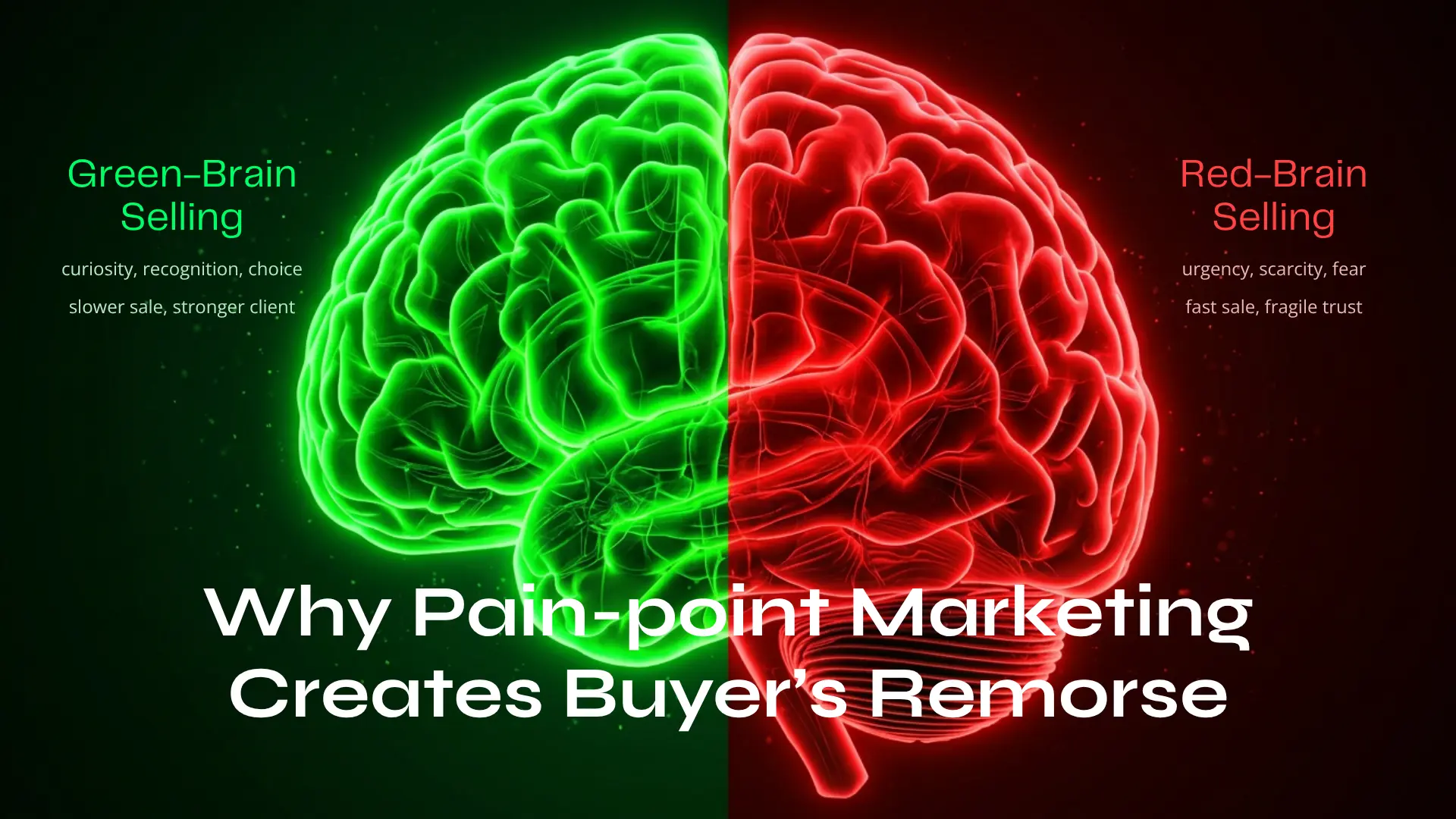
I call this the green brain / red brain selling model. Red brain selling triggers urgency, scarcity, and fear — the amygdala takes over and the prefrontal cortex goes offline, producing fast decisions the buyer often regrets. Green brain selling speaks to curiosity, expansion, and genuine interest — the buyer's prefrontal cortex stays fully engaged, and the decision survives rational evaluation. Both produce a sale. Only one produces a client who's actually glad they bought.
The green brain sale takes longer. I won't pretend otherwise. Someone who finds your blog, reads three posts, checks your offers page, thinks about it for a week, and then books. That's a slower conversion than someone who sees a countdown timer and hits "buy now" at 11:58pm.
But that slower sale produces a client who stays longer, pays more over time, does the work you ask them to do, and sends you people who are just like them. The lifetime value is higher. The referral quality is higher. The actual experience of running your business is incomparably better.
Related, deeper read on the same idea from a different angle: Persuasion vs Pressure: The Line Most Marketing Pretends Doesn't Exist.
What Marketing Without Pain Point Pressure Looks Like in Practice
I'll tell you what I stopped doing and what I do instead.
I stopped running urgency-based launches. No more "doors close Friday" when the doors don't actually need to close Friday. No more manufactured scarcity on things that aren't actually scarce.
I stopped stacking bonuses to inflate perceived value. If the offer needs 17 bonuses to feel worth the price, the offer has a structural problem. The bonuses are a patch.
I stopped writing copy that starts with "Are you tired of..." or "What if you could finally..." or any variation designed to make someone feel bad about where they are right now. I stopped using fear-based marketing tactics entirely, not because they don't convert, but because the conversion produces a client relationship built on the wrong foundation.

What I do instead. I write about what I actually see and think. I share my work visibly enough that people can evaluate my craft before they ever talk to me. I price without apology and without needing urgency to justify it. I have an application process for my higher-end work so the client self-selects before we even get on a call.
The sale happens because the person had time to think clearly and still wanted it. That "still wanted it" part is everything, because it means the desire survived the rational brain's evaluation. It wasn't an impulse that evaporated when the adrenaline wore off. It was a real decision.
Why This Works Beneath Marketing Psychology, in Human Design Terms
There's actually a framework for why this works that goes beyond neuroscience, and I've written about it in detail on my Human Design site. The short version: the founder of Human Design, Ra Uru Hu, taught that all selling is essentially manipulation because you're always speaking to someone's conditioning, their insecurities, their "not-self." And for most marketing, he was right. Pain point selling is a transaction between two conditioned responses.
What he didn't account for is the third category. The person who sees your work, recognises something real, and chooses to engage from a place of genuine curiosity and expansion. That's not conditioning talking. That's the self, fully intact, making a deliberate choice to grow.
If you want the full breakdown of that idea, including why Ra Uru Hu's not-self selling thesis only tells half the story and how Richard Rudd's Gene Keys Pearl Sequence offers a structural alternative, I wrote about it on Human Design ReDefined: Ra Was Half Right.
The Real Question About Pain Point Marketing and the Business It Builds
Pain point marketing works. I've never denied that. What I'm asking is, do you want the kind of business it builds?
Because the kind of clients you get depends on the kind of signal you send. Press on someone's fear and you get fearful buyers who need constant reassurance. Show your craft and let the right person find it, and you get people who already trust your competence before they've paid a cent.
I built Sell Without The Ick as a course because I wanted to lay this out properly, with the frameworks, the psychology, and the practical steps to actually make the shift without going broke in the process. It's €47 and it walks you through the green brain / red brain selling model, what to replace pain point copy with, and how to build a marketing approach that produces clients you actually want to work with.
I don't have a countdown timer on it. Take your time.
Frequently Asked Questions
Pain point marketing is the practice of identifying a potential buyer's fear, frustration, or insecurity and using it as the emotional driver of a sales message. The marketer presses on the pain, agitates it, then offers the product as the relief. It's the default method taught in most online business coaching, and it works in the short term by activating the amygdala (the fight-or-flight system) rather than the prefrontal cortex (the rational evaluation system).
Because the purchase decision is made under amygdala activation, not rational evaluation. When the buyer's adrenaline drops (often within hours), the prefrontal cortex comes back online and asks the questions that were never answered: do I actually need this, is this person actually qualified, did I research this enough. The remorse is a predictable neurological outcome of the method, not a character flaw in the buyer.
No. Pain point marketing is one specific kind of manipulation, but it's not the only way to sell. The alternative is what I call green brain marketing: making your thinking visible, showing the quality of your work, and letting the right buyer recognise the fit on their own timeline. Both approaches produce sales. Only the second produces clients who stay, refer, and don't ask for refunds.
Red brain selling activates fear, urgency, and scarcity. It uses countdown timers, manufactured deadlines, "doors close Friday" tactics, and pain-point hooks. The amygdala takes over and the prefrontal cortex goes offline, producing fast decisions the buyer often regrets. Green brain selling demonstrates craft, makes the offer clearly visible, and lets the buyer make a considered decision from curiosity rather than panic. The buyer's prefrontal cortex stays fully engaged, and the decision survives rational evaluation. The green brain sale takes longer and produces a higher-quality client. The full structural breakdown lives inside Sell Without The Ick.
Yes, and in my experience it's more profitable across the lifetime of a business than pain point marketing. Pain point conversion is faster per individual sale, but green-brain clients stay longer, pay more across multiple offers, and refer people who behave the same way. The lifetime value is higher, the refund rate is lower, and the founder doesn't burn out from chasing high-pressure launches. The trade-off is patience, not profit.
The Course That Replaces Pain Point Copy
Sell Without The Ick walks you through the green brain / red brain selling model, the patterns to replace, and the seven-point checklist I use to catch pressure tactics before copy leaves my desk. It's €47. No countdown timer. Take your time.
Get the Course // €47 Or read the companion piece: Persuasion vs Pressure →If any link above has changed, check the Work With Me section in the menu for current offers.